[Context Series] Screen with Flower-and-Bird Paintings by Feng Kaijia in the Qing Dynasty 〔文脉系列〕《清冯开甲花鸟图屏》

Do you feel the vibe of early spring after
the day of Lichun (the beginning of
spring)? All creatures in nature, as well
as people's moods, are waking up with
the weather.
立春过后,朋友们是否感受到了早春的气息?与天气一起苏醒的,有自然中的万物,也有人们的心境。
The Day of Lichun, a poem by the
Southern Song poet Lu You, depicts
the vibrant scene in Hucun Village when
spring was approaching: "In the warm
sun and gentle breeze, I woke up after a
hangover. Living in the mountain, I have
the rest of my life filled with happiness.
There have been three heavy snows,
heralding a year of bumper harvest. It
is getting warm and the suburbs are
already green. It is time for eating
pancakes with tender vegetables and
flowers. The wine is mellow, with the
scum overflowing the long bottle. The
beauty of the village is beyond
description, which is painted on the
screens of the rich." How graceful it
would be if spring could be left on the
screen.
陆游的《立春日》描绘着春日将至时湖村生机勃勃的景象:“日出风和宿醉醒,山家乐事满余龄。年丰腊雪经三白,地暖春郊已遍青。菜细簇花宜薄饼,酒香浮螘泻长瓶。湖村好景吟难尽,乞与侯家作画屏。”如果能把春意留作画屏,该是多么风雅之事。
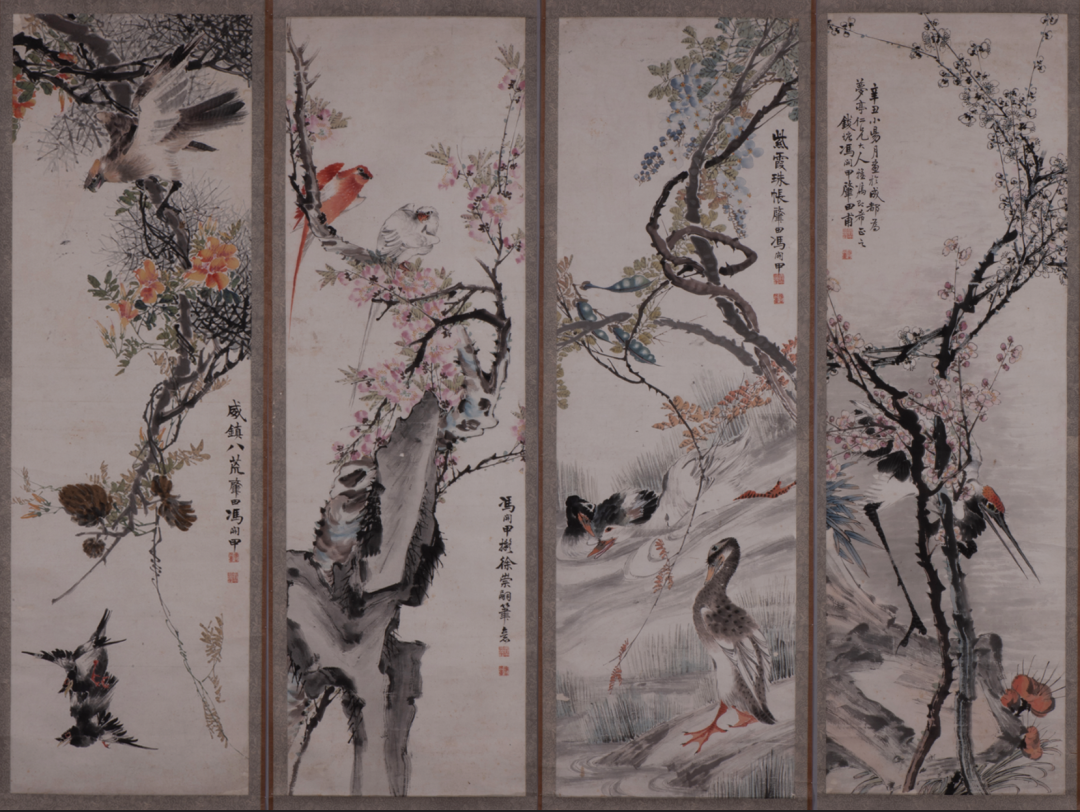
Today, we will appreciate a selected
calligraphy and painting work collected
by Wenjiang Museum, which is called
"Screen with Flower-and-Bird Paintings
by Feng Kaijia in the Qing Dynasty". At
this time when everything comes back to
life, let's admire the work for the natural
fun it contains.
今天,我们就一起来欣赏温江博物馆馆藏的精品书画《清冯开甲花鸟图屏》,让我们在此万物回春之际,感受书画中蕴含的自然情趣。
The work is a screen with water and ink
flower-and-bird paintings on paper,
which consists of four panels.
本作为纸本,水墨设色花鸟屏,一屏共四幅。
Panel I
画屏一
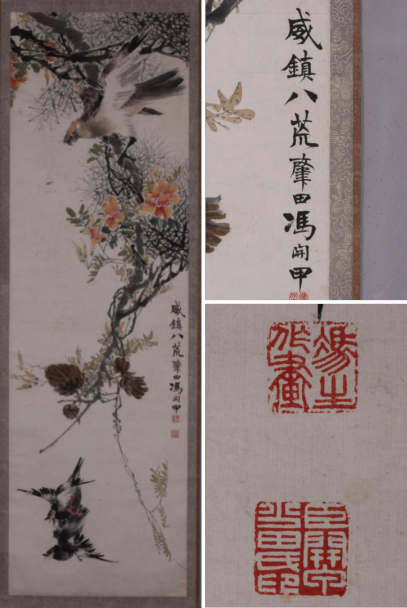
There is an old pine tree, a goshawk, and
a pair of swallows in the painting. In the
upper part of the painting, the pine tree is
straight and upright with pine cones and
red flowers. On the branch, there is a
goshawk spreading its wings and crowing;
under the branch, there is a pair of
swallows flying up and down. The birds
are finely painted using the technique of
dry brush outlining and texturing, with
every feather presented vividly, while the
tree is painted using the technique of
rough brush outlining and coloring. So
there is a contrast between roughness
and fineness, motion and stillness.
There is a line of nine characters in
semi-cursive script on the right side in
the middle part of the painting, reading "
Hold the World in Awe, by Feng Kaijia
with Courtesy Name Zhaotian (威镇八荒,
肇田冯开甲)". At the end of the inscription,
there is a square seal with red lettering
reading "Painted by Feng Sheng (冯生作
画)" and a square seal carved in intaglio
reading "Seal of Kaijia with Clan Name
Shaotian (臣开甲少田氏印)".
写古松、苍鹰、双燕。上部古松挺劲,其间穿插松果、红花,松枝上一苍鹰展翅,作啼叫状,松枝下双雁翻飞,干笔勾皴的毛羽精细入微,毫发毕现,情趣生动,与松枝的粗笔勾染,形成粗与细、动与静的对比。中部右侧有行书款一行九字。曰:“威镇八荒,肇田冯开甲”。款尾有朱文方印“冯生作画”和白文方印“臣开甲少田氏印”。
Panel II
画屏二
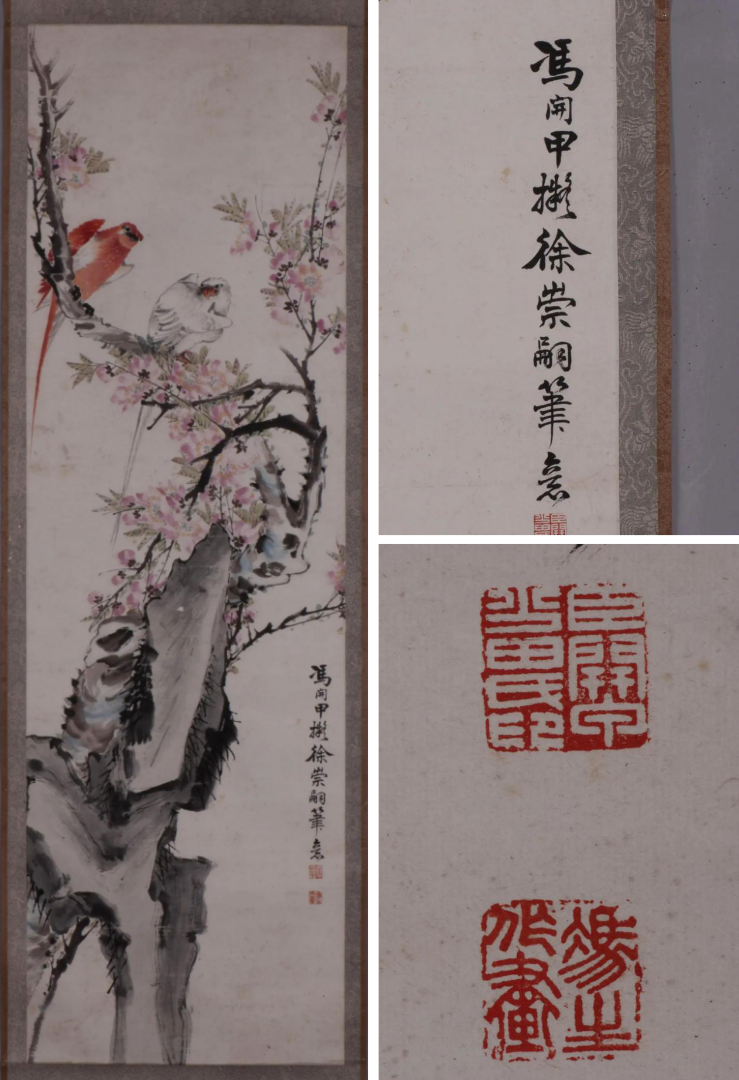
There are parrots, peach blossoms and a
rock in the painting. Its upper part is a
branch of peach blossoms with petals in
powder coating, leaves rendered in green,
and leaf veins outlined with ink, looking
simple while bright and clean. There is a
pair of parrots on the branch, one in red
and the other in white. The feathers of the
parrots are finely painted using the
technique of dry brush outlining and
texturing, which makes the birds look
vivid. There is a bizarre rock in the lower
part, which is outlined with light ink and
dotted with thick ink as moss. There is a
line of nine characters in semi-cursive
script on the right side in the middle part
of the painting, reading "By Feng Kaijia
Following the Painting Style of Xu
Congsi (冯开甲擬徐崇嗣笔意)". At the
end of the inscription, there is a square
seal with red lettering reading "Painted
by Feng Sheng (冯生作画)" and a square
seal carved in intaglio reading "Seal of
Kaijia with Clan Name Shaotian (臣开
甲少田氏印)".
写鹦鹉、桃花、怪石。上部画桃花一枝,花瓣用撞粉法,叶用绿色渲染后再用墨勾叶筋,笔墨简逸,设色明净。桃花枝上停鹦鹉两只,一红一白,干笔勾皴的毛羽精细入微,情趣生动,下部为怪石一块,淡墨勾勒轮廓,加浓墨点苔。中部右侧有行书款一行九字,曰:“冯开甲擬徐崇嗣笔意”。款尾有朱文方印“冯生作画”和白文方印“臣开甲少田氏印”。
Panel III
画屏三
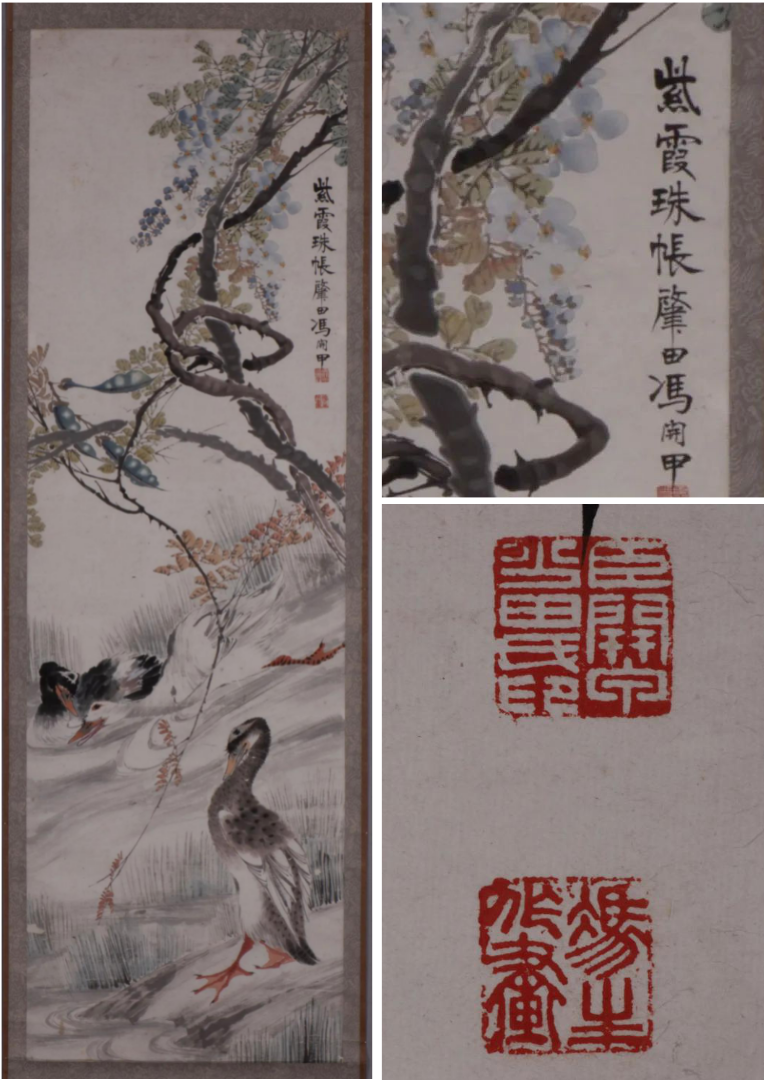
This panel depicts wisteria and ducks. Its
upper part is a three-branched wisteria
with petals in powder coating and leaves
rendered in green, looking simple while
bright and clean. Branches are thick in
ink with smooth lines. Under the wisteria
is a stream where two ducks are playing.
Another ink-colored duck is resting, with
a few water plants dotted around it. There
is a line of nine characters on the right
side of the upper part, reading: "Purple
Beaded Curtain by Feng Kaijia with
Courtesy Name Zhaotian (紫霞珠帐,
肇田冯开甲)". At the end of the inscription,
there is a square seal with red lettering
reading "Painted by Feng Sheng (冯生作
画)" and a square seal carved in intaglio
reading "Seal of Kaijia with Clan Name
Shaotian (臣开甲少田氏印)".
写紫藤、鸭子。上部画紫藤三枝,花瓣用撞粉法,叶用绿色渲染,笔墨简逸放纵,设色明净。枝干粗笔浓墨勾染,水墨酣畅。紫藤下有一溪流,双鸭游戏其间,另有一墨色鸭子作休息状,其间点缀水草数株,上部右侧有行书款一行九字,曰:“紫霞珠帐,肇田冯开甲”。款尾有朱文方印“冯生作画”和白文方印“臣开甲少田氏印”。
Panel IV
画屏四
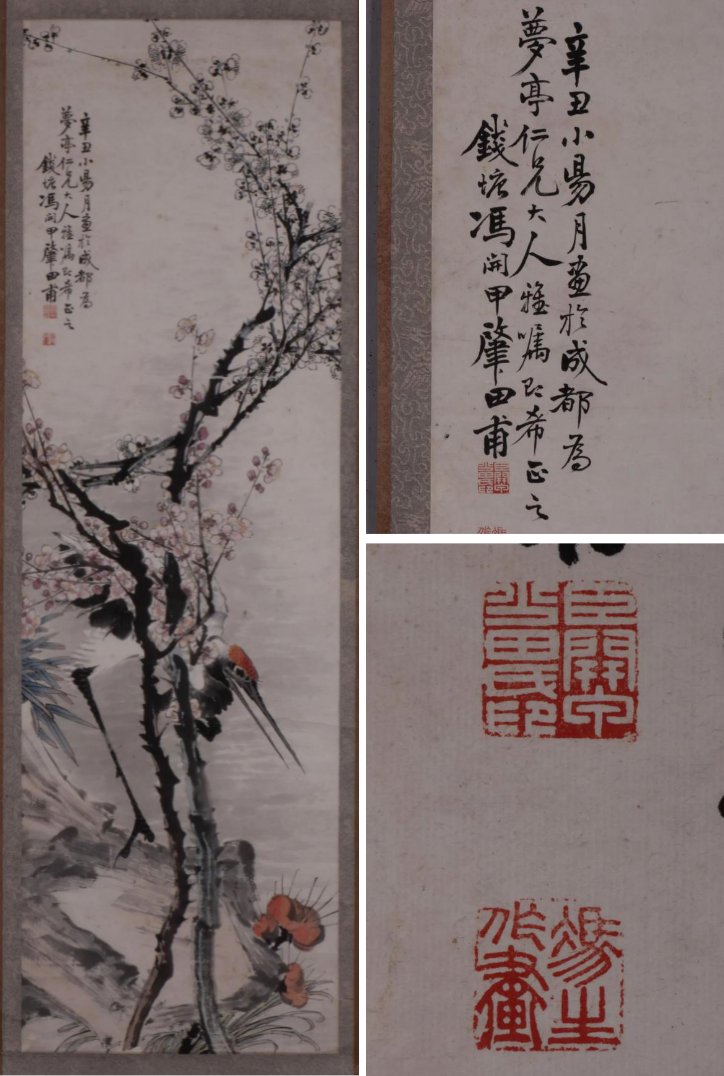
In the upper part, two ancient plum trees
are painted with pure ink, with strong and
straight branches and dense stamens.
Outlined in light red, the plum blossoms
look brilliant as jade, luxuriant but
uncluttered. Under the plum blossom
branches are a red-crowned crane, lingzhi
and narcissus, all auspicious objects for
Chinese people. There are three lines of
30 characters on the left side of the upper
part, reading: "Painted in Chengdu in
November in the year XinChou for Mr.
Mengting's appreciation and comment.
By Feng Kaijia with Courtesy Name
Zhaotian in Qiantang County (辛丑小阳
月画于成都为梦亭仁兄大人雅属即希正
之。钱塘冯开甲肇田甫)". At the end of
the inscription, there is a square seal
with red lettering reading "Painted by
Feng Sheng (冯生作画)" and a square
seal carved in intaglio reading "Seal of
Kaijia with Clan Name Shaotian (臣开
甲少田氏印)".
上部以干笔枯墨画古梅二株,枝干劲健挺拔,花蕊芯繁密,花用勾勒法,墨略施红彩,衬托出梅花盛开,灿烂如玉,繁而不乱的景色,梅花枝下点缀仙鹤、灵芝、水仙等祥瑞。上部左侧有行书款三行30字,曰:“辛丑小阳月画于成都为梦亭仁兄大人雅属即希正之。钱塘冯开甲肇田甫”。款尾有朱文方印“冯生作画”和白文方印“臣开甲少田氏印”。
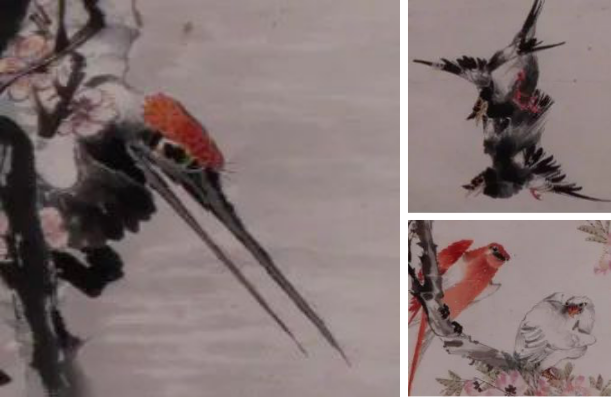
At the start of spring, everything will
come back to life. Then the scenes in
these paintings will gradually appears
around us. We may as well learn from
the aspirations of the ancients and record
and taste the beauty of life.
“泥牛鞭散六街尘,生菜挑来叶叶春。从此雪消风自软,梅花合让柳条新。”立春过后,画中春意渐渐出现于我们身边,不妨学古人志趣,一起记录和品味生灵之美。

来源 Source | 成都市温江区博物馆
排版 Typesetting | 赵术君
审核校对 Senior Editor | 陈倩



评论